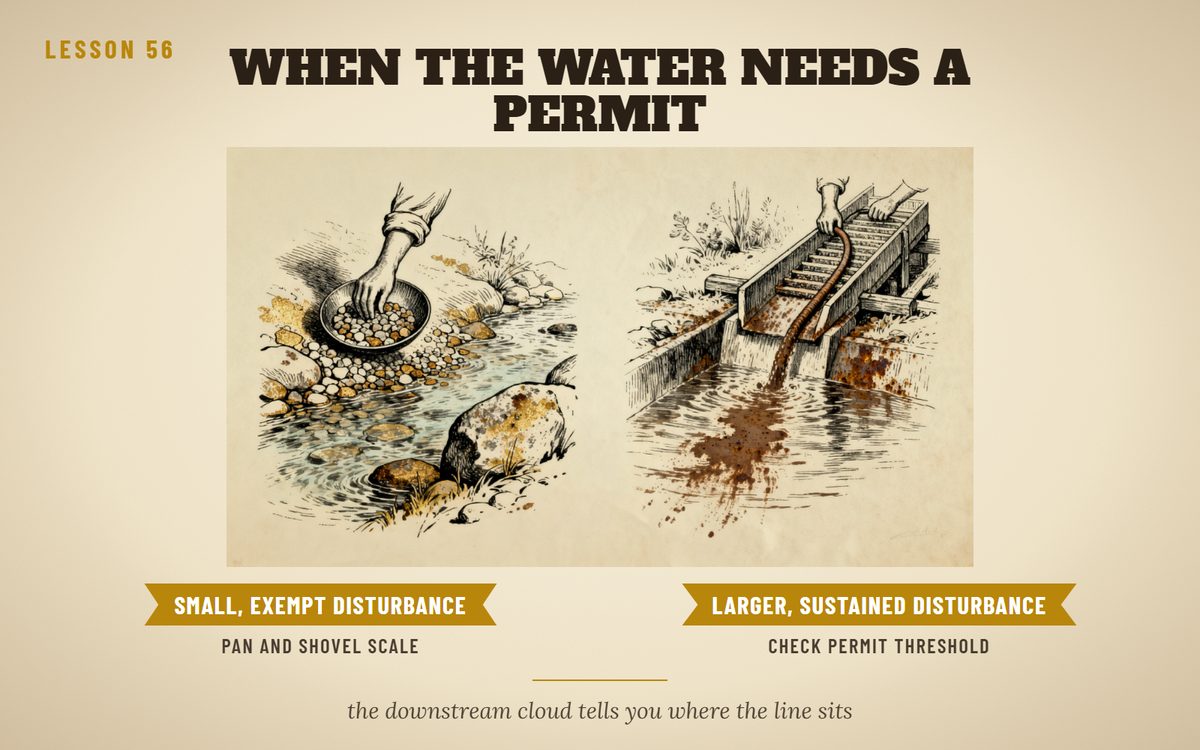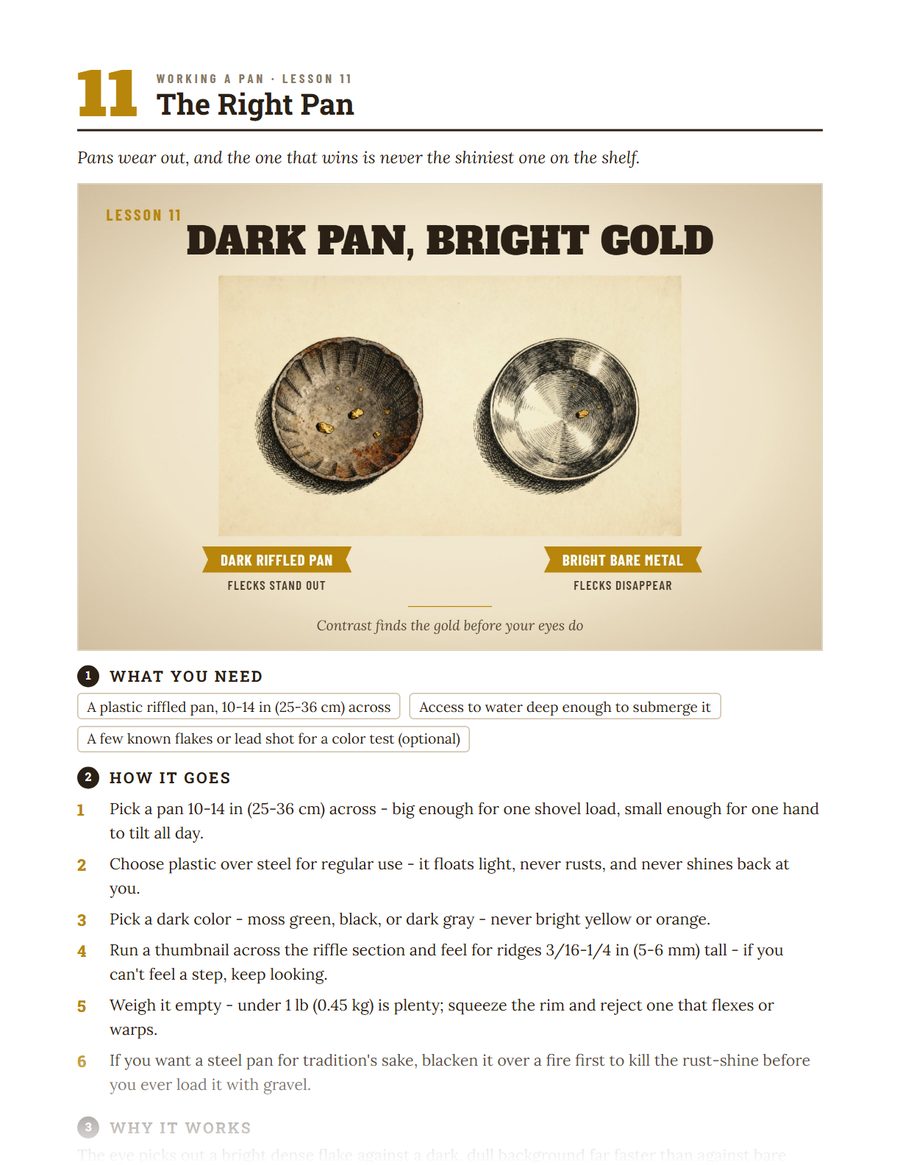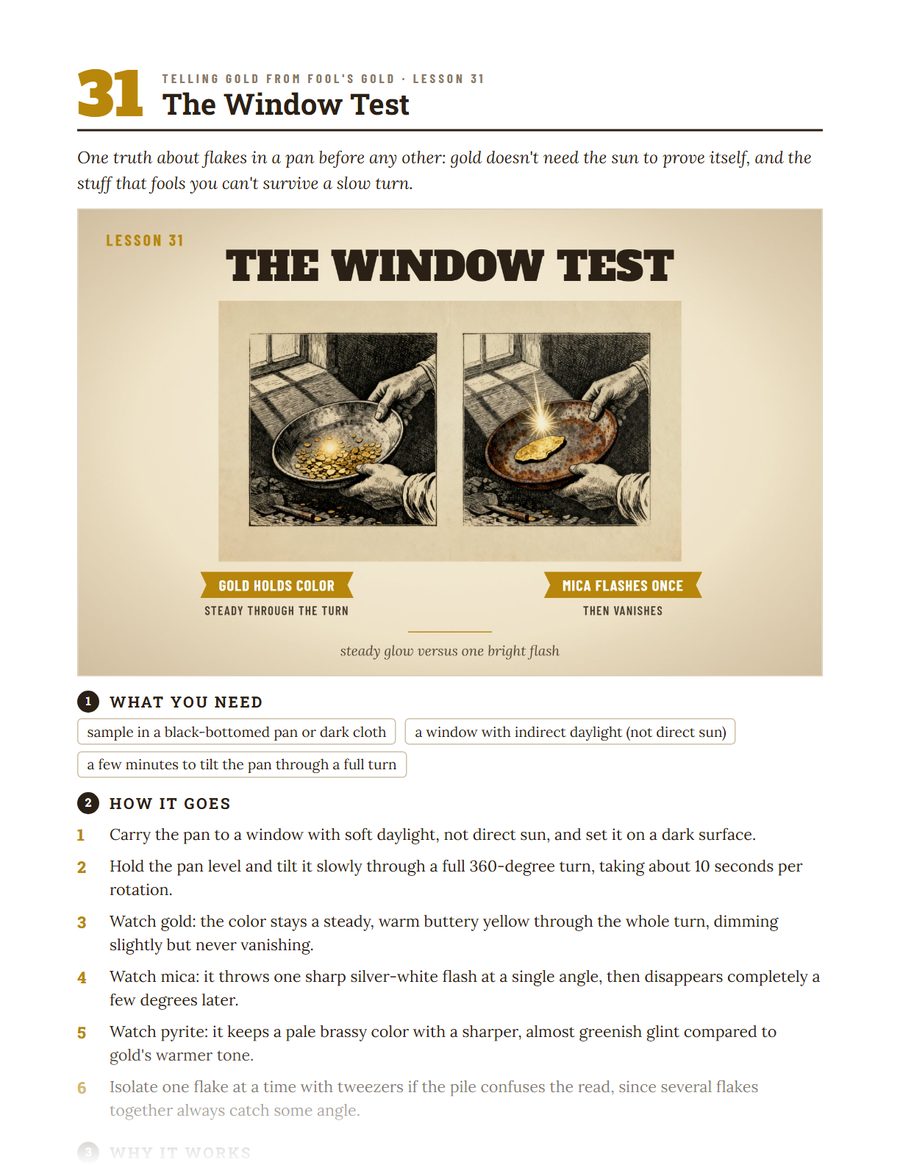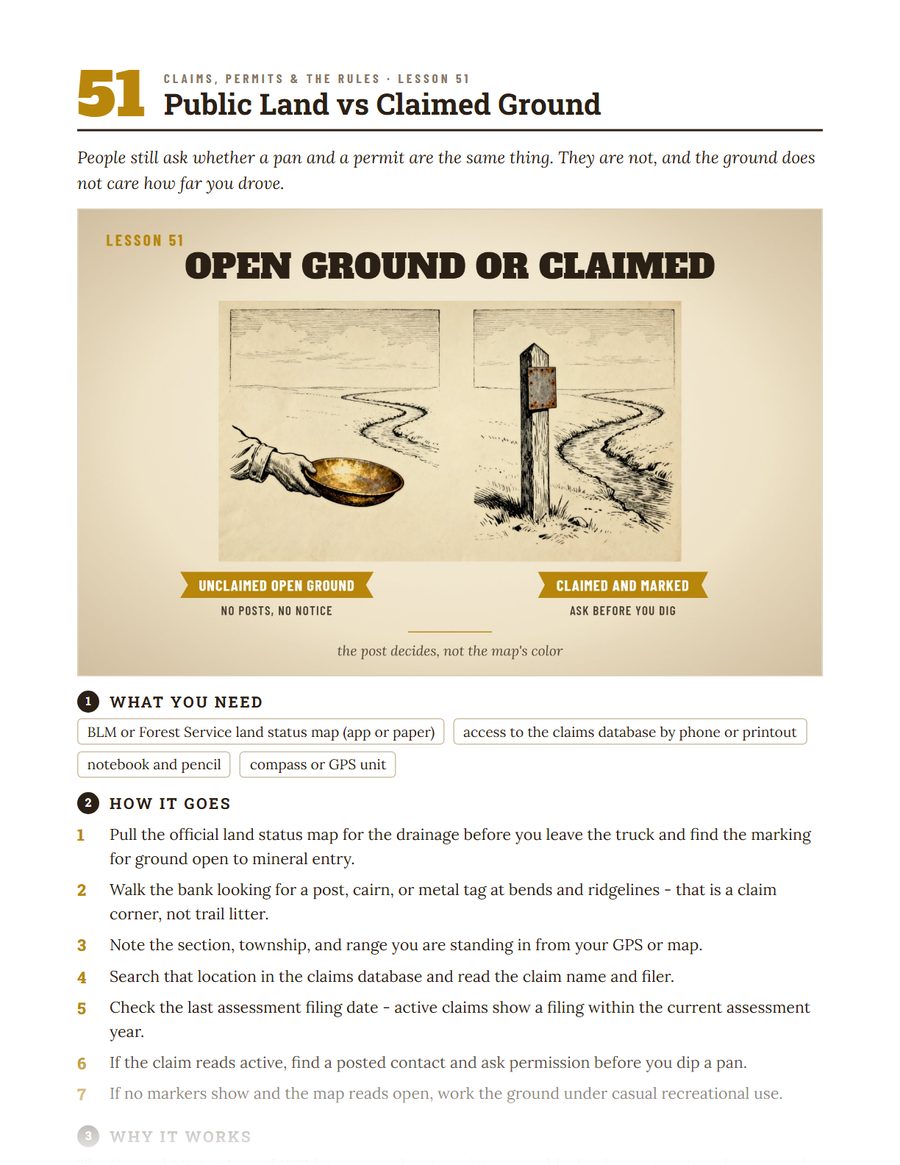
Sixty lessons, six sections, one book: how to read a creek bend before you ever load a pan, how to run that pan all the way to black sand, how to set a sluice so it clogs less by noon, how to tell real gold from mica and pyrite without a lab, what the ground can hurt you with, and how to check whether the ground is even yours to touch. Sixty drawings, 179 named mistakes, a 168-entry symptom index. It doesn't need signal, or Wade, or a guess.
By buying you agree to the Terms of Sale and Refund Policy.
0 people went to checkout in the last 24 hours
PDF · 145 pages · 60 illustrated lessons · read on phone, tablet or computer, or print it
This is for the moment you're standing at a bend with wet boots, a pan in one hand, and a question the comments section can't answer fast enough. It's the same method from the channel, written out in order, so you can check your own work without waiting for a reply.
The back of the book runs 168 symptoms straight to the lesson that explains them, so you search by what went wrong, not by a chapter title you half-remember from a video.
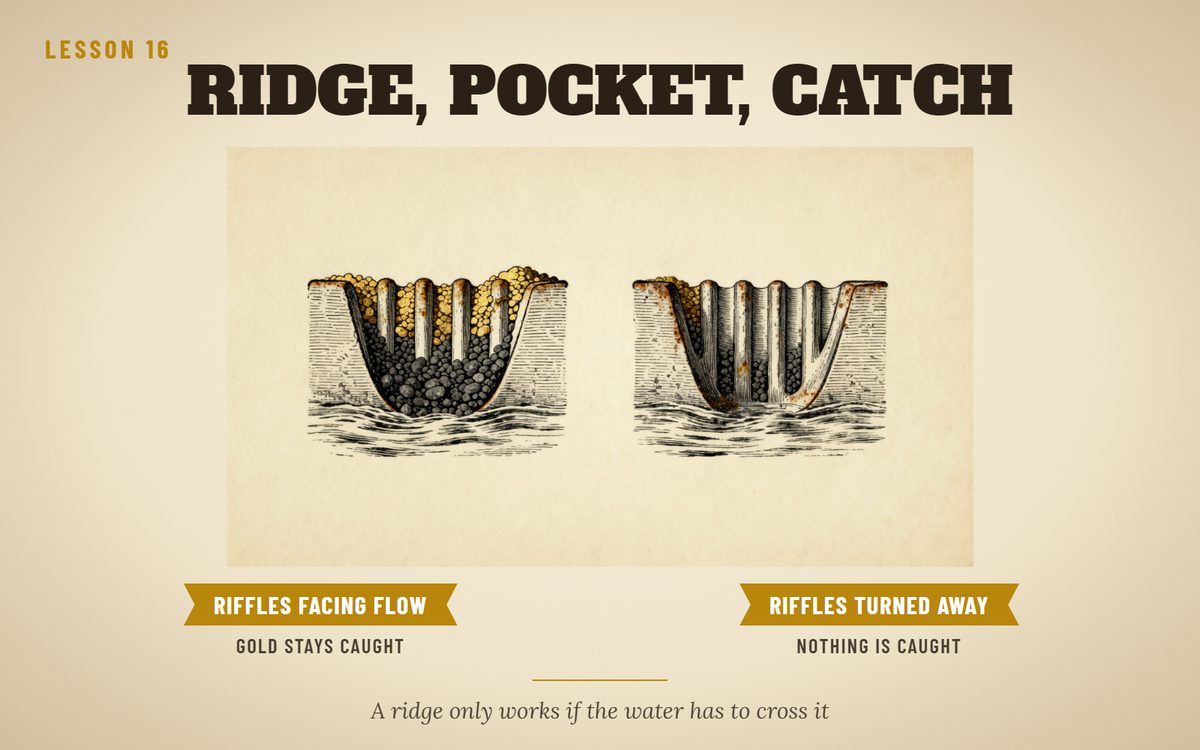
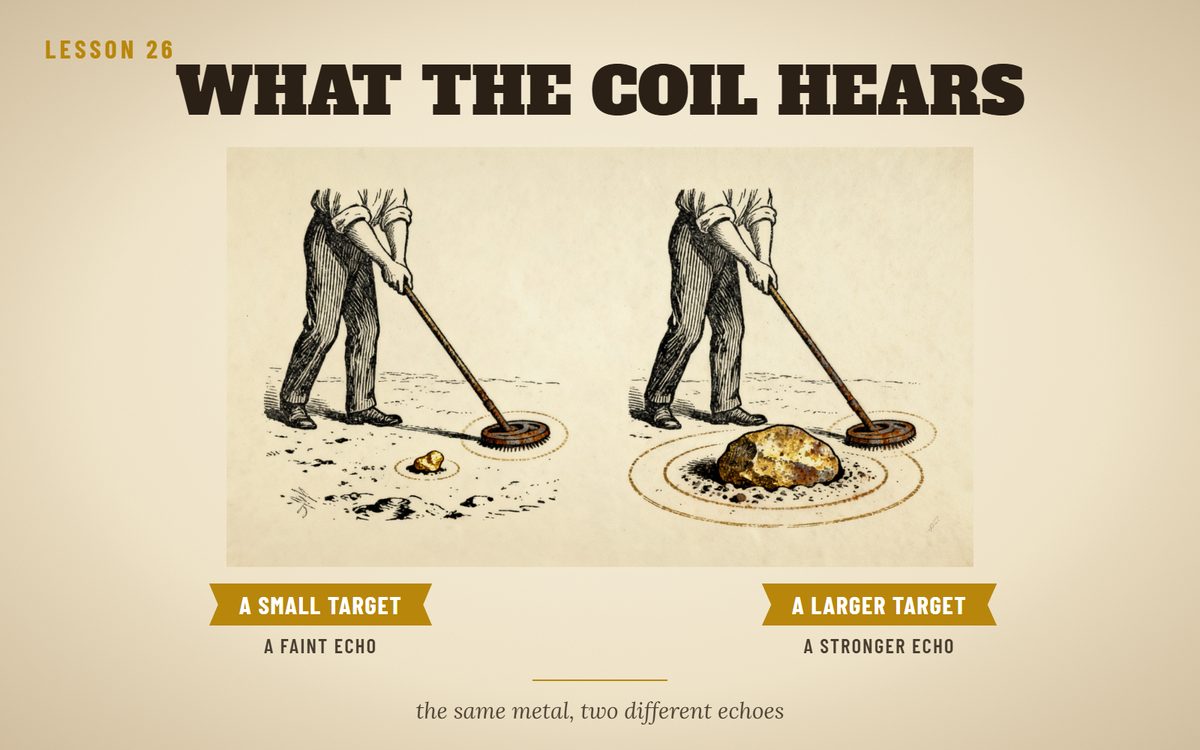
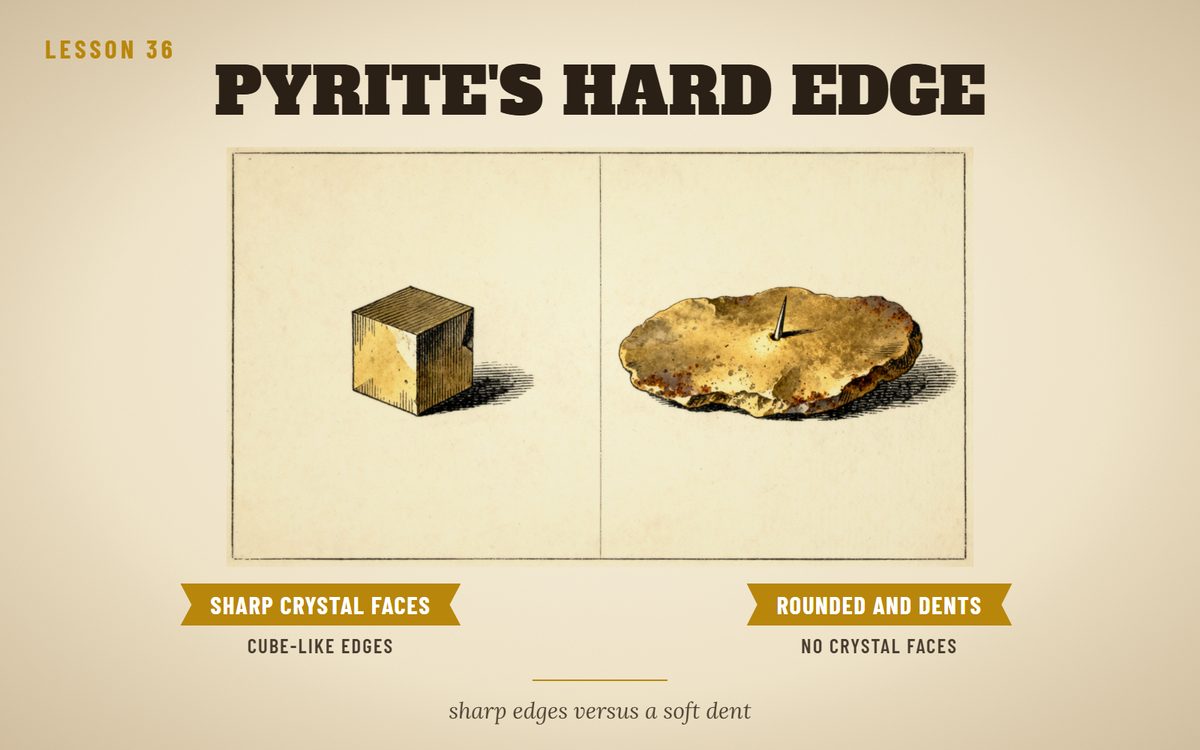
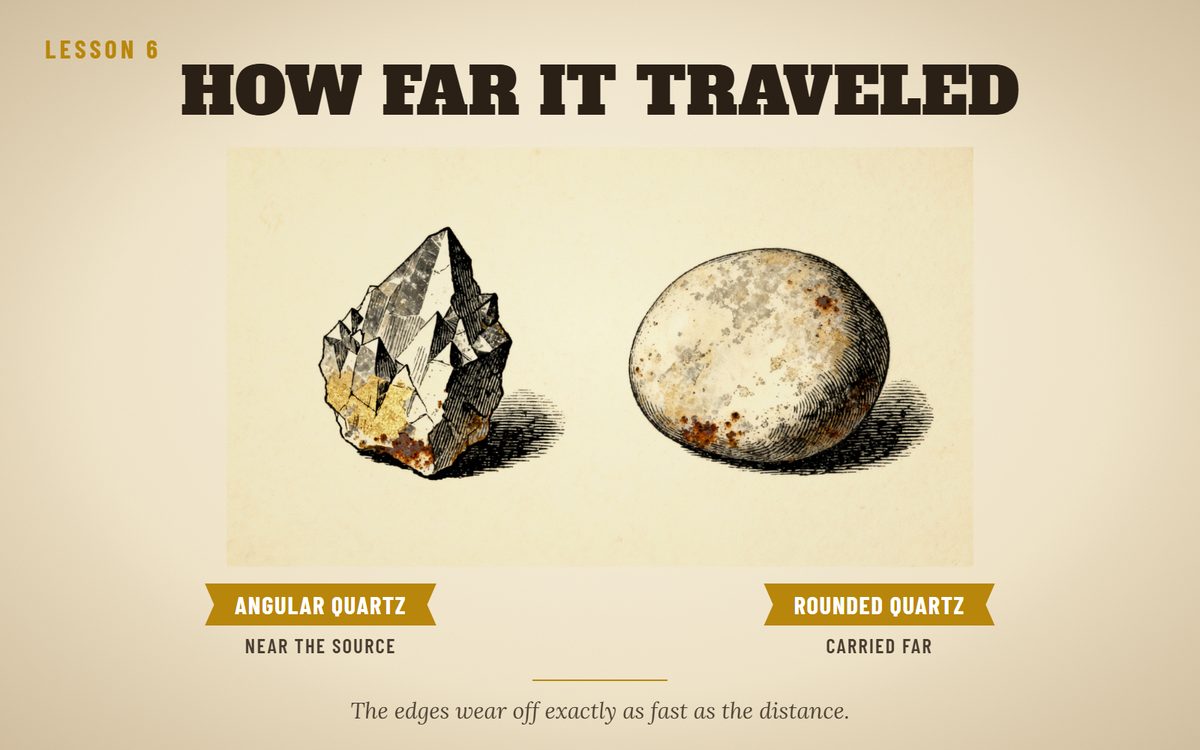
60 lessons, 60 drawings — the inside bend, the riffle angle, the claim marker — so you can check your work against a picture, not just your memory of the text.
179 mistakes, each named the way it looks when it's going wrong, then exactly what to change.
153 measurements pulled into a reference section — pan sizes, riffle heights, grade angles — so you can look one up fast without rereading the whole lesson.
A single guided panning day with an outfitter in gold country typically runs $50 to $120 a person — one creek, one day, on someone else's schedule, with someone else's gear. This book runs $37, once, and you keep it for every creek you'll ever stand at after.
Guide prices are typical and vary by region, season, and outfitter — this is a point of reference, not a quote.
One book, six parts, sixty lessons — reading water, running a pan and a sluice, telling gold from everything that fakes it, staying clear of what the ground can hurt you with, and knowing which ground is yours to work.
Sixty lessons, sixty drawings — the bend, the riffle, the claim marker — so you can check the page against the picture, not just the memory of a video.


A video can show you the bend. It can't stand there with you.
Every video on the channel teaches one piece of the method — one bend, one test, one mistake. That works at home. It doesn't work knee-deep in a creek with no signal, when the question you have is the one the video didn't cover.
So the whole method went into one book, in the order you actually need it: read the water, work the pan, run the gear, tell gold from what fakes it, stay clear of what the ground can hurt you with, and know which ground is yours to work. Every lesson names its mistakes and says where it stops working, because a method that claims to work everywhere is one nobody tested.
It's not a replacement for the channel. It's what the channel can't do, which is ride in the truck with you.
— Wade

Wade Tucker hosts Tucker Gold Rush, a channel about finding gold the small-scale way: panning, sluicing, metal detecting, reading a creek, and the rules of where you're allowed to dig.
This book is the channel's method, organized: sixty numbered lessons in six parts, each with what you need, the steps with the real numbers, why it works, how people ruin it and where it doesn't hold — plus a drawing for every lesson, a 168-problem index and a one-page cheat sheet to print.
Every safety and legal claim in it was checked against official guidance from the BLM, the Forest Service, NIOSH and OSHA before it shipped.
“The water already sorted it for you. Your job is just to not undo its work.”
One digital book, The Placer Gold Primer — 60 lessons across six sections, each with steps, a drawing, the named mistakes with fixes, and the honest limits of the method, plus a back-of-book index of 168 symptoms and a reference section of 153 numbers.
Checkout runs through Stripe — card, Apple Pay, or Google Pay. The download page opens right after payment, and the PDF links work straight from that page.
Yes. It's built to be printed and carried — the whole point is having it on paper at the creek, where there's no signal.
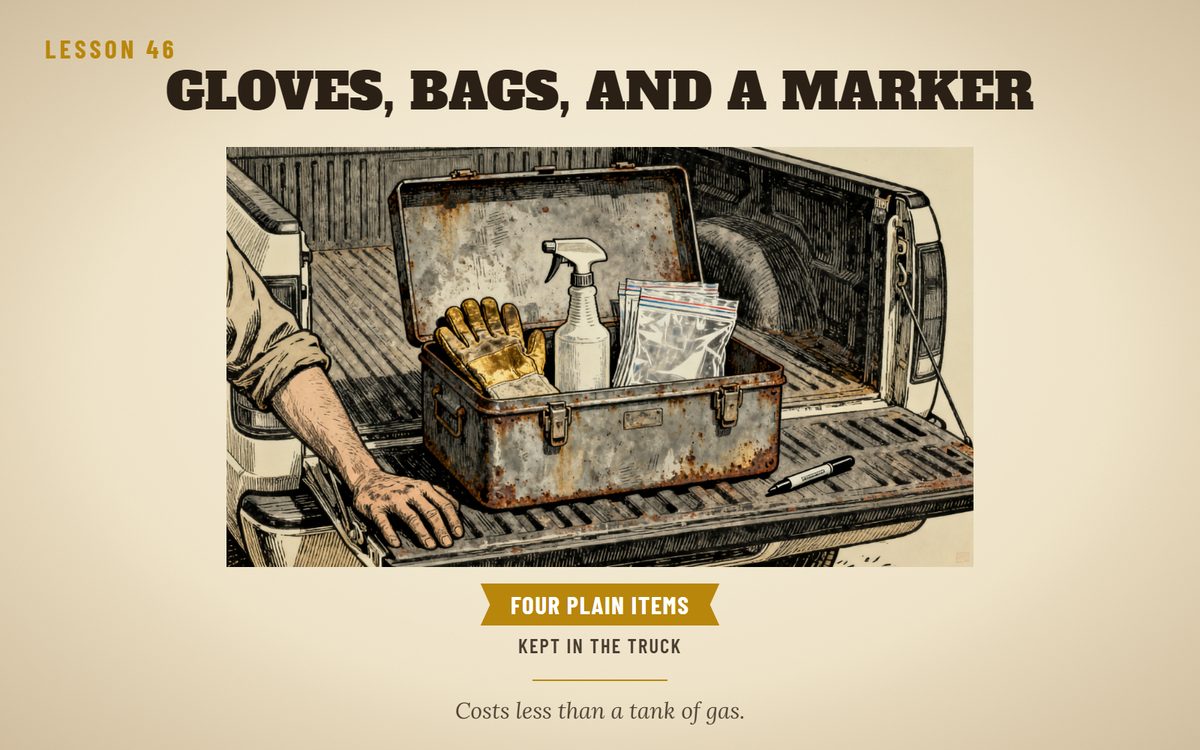
The hazard section, Lessons 41 through 50, covers the minerals to leave alone, gloves and washing up, and why you stay out of old workings entirely. Every safety and legal claim was checked against official guidance (BLM, the Forest Service, NIOSH, OSHA). No book replaces judgment at the actual site — if a slab, a mineral, or an old working looks wrong, leave it and ask someone local.
You get 14 days to decide. If it's not useful, you get your money back — no form to argue with.
Stripe checkout, $37, one time — card, Apple Pay, or Google Pay.
Sixty lessons, one book, $37 — read it before you go, or keep it in the truck for when you need it.
By buying you agree to the Terms of Sale and Refund Policy.
0 people went to checkout in the last 24 hours